Keeping your commercial premises electrically safe isn't just good practice, it's a legal and moral obligation. HRB Mech carries out commercial electrical installation condition reports (EICRs) for businesses and commercial property operators across the UK, providing the certified documentation you need to demonstrate compliance, protect your people, and operate with confidence.
What Is a Commercial EICR?
A commercial electrical installation condition report, commonly referred to as a commercial EICR, is a formal assessment of the electrical installation within a commercial property. Carried out by a qualified electrician, it evaluates the condition, safety, and integrity of all fixed electrical systems, identifying any defects, deterioration, or non-compliance with current electrical safety standards.
The resulting EICR certificate provides a documented record of the installation's condition at the time of inspection, confirms whether the property is electrically satisfactory, and outlines any remedial work required to bring it up to the required standard.
All commercial EICRs carried out by HRB Mech are conducted in accordance with BS 7671, the IET Wiring Regulations, which is the nationally recognised standard for electrical installations in the UK.
It's worth being clear on the distinction between a commercial and a domestic EICR. Commercial electrical systems are considerably more complex, with higher-capacity circuits, three-phase supplies, industrial switchgear, distribution boards serving multiple zones, and a greater density of connected equipment. A commercial EICR requires engineers with the experience and competency to assess these systems accurately, not just a qualified domestic electrician.
Is a Commercial EICR a Legal Requirement?
The short answer is yes, though the legal picture is slightly more nuanced than a single piece of legislation spelling it out.
In the UK, the duty to maintain safe electrical installations in commercial premises is established across several pieces of legislation:
The Electricity at Work Regulations 1989 place a legal duty on employers and those in control of workplaces to ensure that all electrical systems are constructed, maintained, and operated in a way that prevents danger. Periodic inspection and testing is the recognised method of demonstrating compliance with this duty.
The Health and Safety at Work Act 1974 requires employers to provide a safe working environment for employees and visitors. Undetected electrical faults are a leading cause of workplace fires and electric shock incidents; regular EICR testing is a fundamental part of managing that risk.
The Landlord and Tenant Act 1985 and associated regulations place obligations on commercial landlords to ensure that electrical installations are safe at the start of a tenancy and maintained in satisfactory condition throughout.
Beyond the legislation itself, most commercial insurers require evidence of regular electrical inspection and testing as a condition of cover. An expired or absent EICR can invalidate your insurance policy in the event of an electrical incident, a risk no business should take.
Failure to maintain a compliant electrical installation can result in enforcement notices from the local authority or Health and Safety Executive, fines, and, in serious cases, prosecution.
How Often Does a Commercial Property Need an EICR?
The recommended testing frequency for a commercial EICR depends on the type of property and how it is used. As a general guide:
- Offices and standard commercial premises - every 5 years
- Industrial units, manufacturing facilities, and high-risk environments - every 3 years
- Premises with a change of occupancy or significant change of use - before the new occupancy begins
- Hotels, care homes, and schools - every 5 years, though many opt for more frequent testing given the duty of care involved
- Temporary or construction site installations - every 3 months
It's also important to note that your previous EICR report may specify a shorter testing interval based on the condition of the installation at the time. That recommendation is not advisory, it forms part of your compliance record and should be followed.
If you're unsure when your property was last tested, or you've taken on a new commercial premises without an existing EICR, the right course of action is to book an inspection as soon as possible rather than wait for a specified interval.
What Does a Commercial EICR Involve?
A commercial electrical installation condition report is more thorough than many property managers expect. It isn't a quick visual check; it involves a structured programme of inspection and testing that may take several hours or, for large commercial premises, more than one day.
Here's what the process involves:
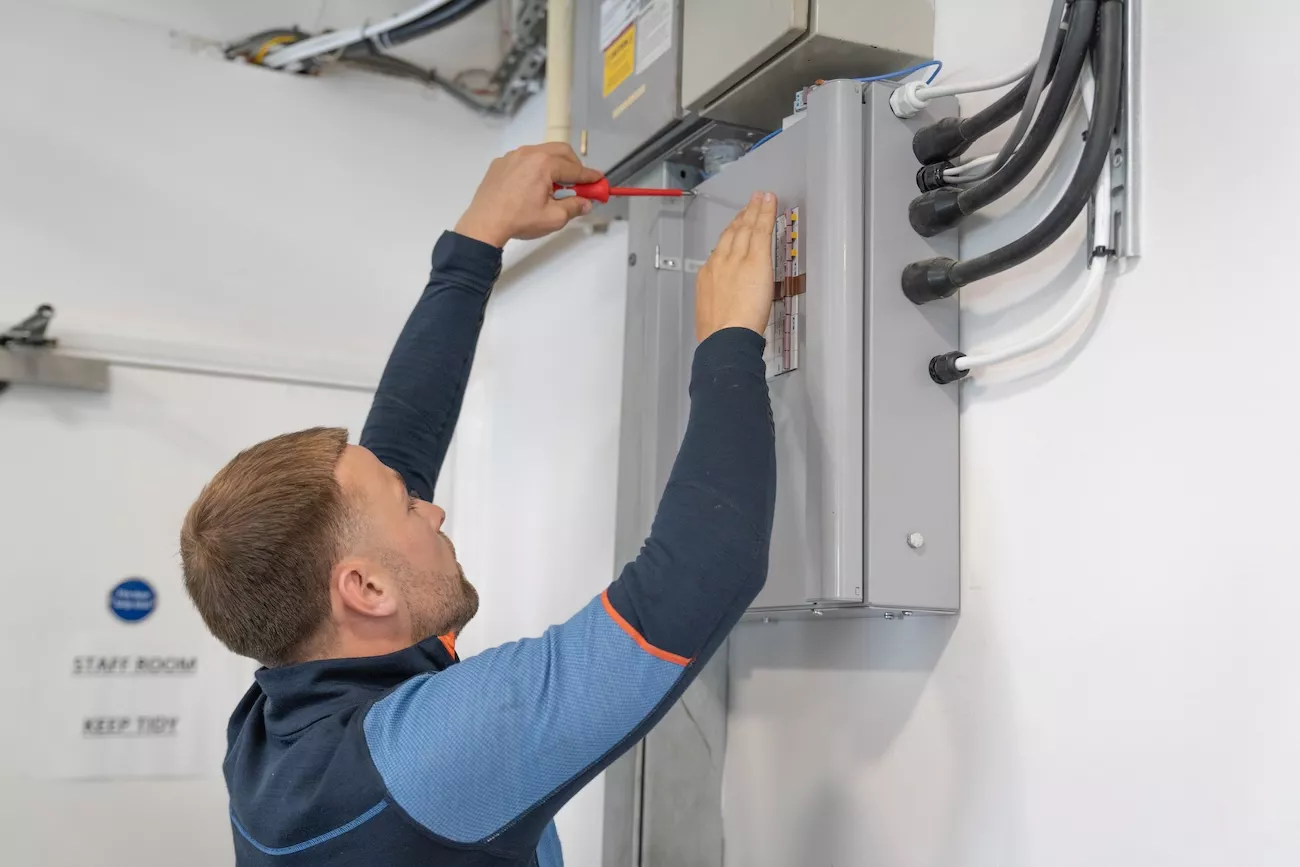
Visual inspection: A thorough examination of all accessible fixed electrical installations, including consumer units, distribution boards, switchgear, wiring systems, sockets, lighting circuits, and any specialist electrical equipment forming part of the fixed installation. The engineer is looking for signs of damage, deterioration, overloading, poor workmanship, and any obvious non-compliance.
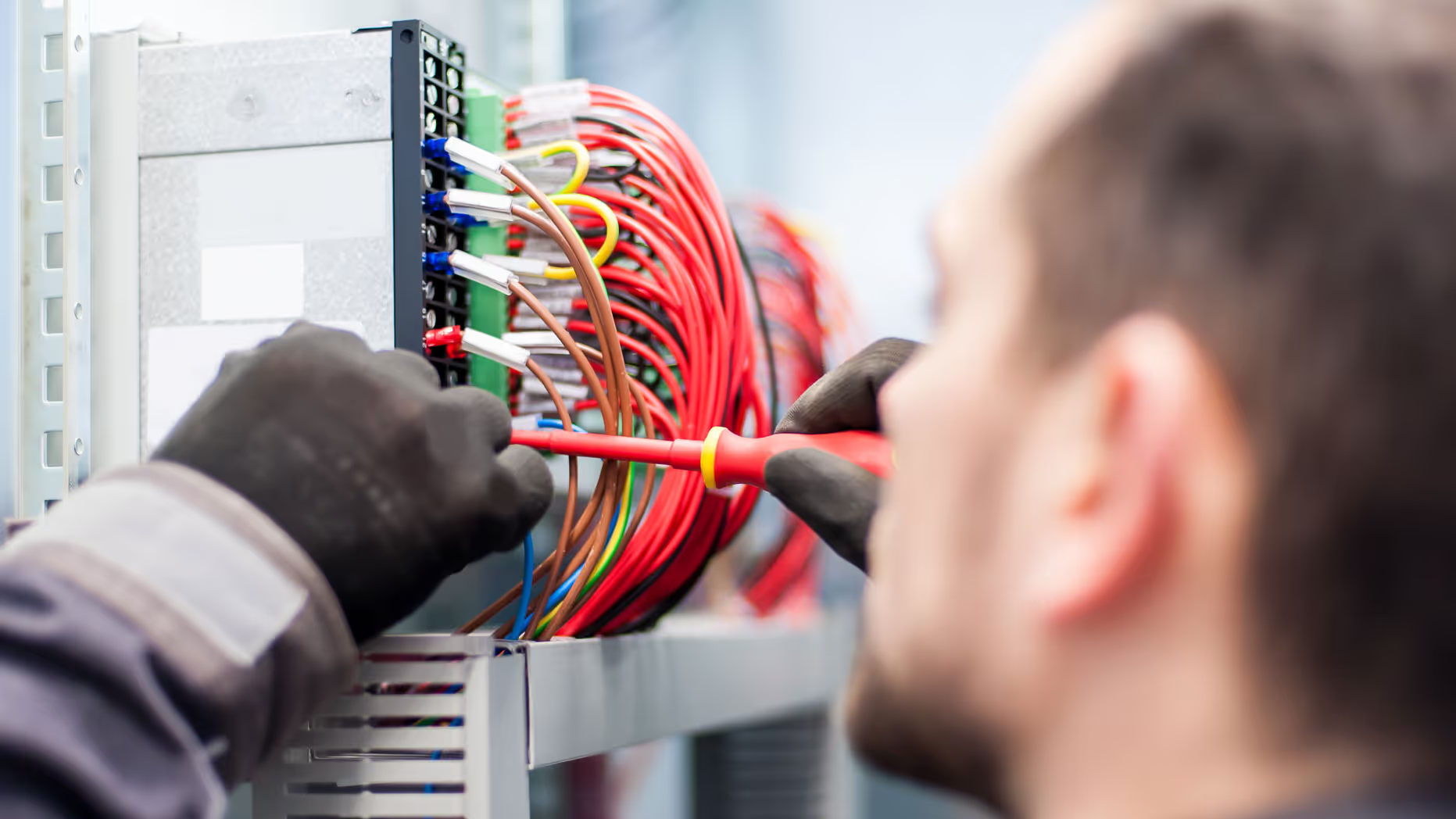
Dead testing: The electrical circuits are isolated and tested for continuity of protective conductors, ring final circuit continuity, and insulation resistance. This identifies hidden faults, damaged insulation, broken conductors, or deteriorated wiring that wouldn't be visible during a visual inspection alone.
Live testing: Once dead testing is complete, the installation is re-energised and tested under normal operating conditions. This includes earth fault loop impedance testing and residual current device (RCD) testing to verify that the installation's protective devices will operate correctly in a fault condition.
Documentation and certification: The findings from the full inspection and test programme are recorded and compiled into the formal EICR report. Each circuit and component is assessed and classified. The report concludes with an overall determination: either Satisfactory, meaning the installation is in a safe condition for continued use, or Unsatisfactory, meaning remedial work is required before the installation meets the required standard.
What Do the EICR Codes Mean?
Every defect or observation recorded during a commercial EICR is assigned a classification code. Understanding these codes is important for any property manager or business owner receiving a report.
C1 - Danger present: The defect poses an immediate risk of injury. A C1 classification requires action without delay — in some cases, the affected circuit or installation may need to be taken out of service immediately.
C2 -Potentially dangerous: The defect is not causing immediate danger, but could do so. Urgent remedial work is required. A C2 code results in an Unsatisfactory EICR and must be addressed within the required timeframe.
C3 - Improvement recommended: The defect is not dangerous but falls short of current best practice. A C3 code does not in itself result in an Unsatisfactory EICR, but the improvement should be considered, particularly if the installation is due for any upgrading works.
FI - Further investigation required: Something has been identified during the inspection that cannot be fully assessed without additional investigation. This should be followed up as a matter of priority, as further investigation may reveal a C1 or C2 condition.
A Satisfactory EICR is one where no C1 or C2 codes are present. An Unsatisfactory EICR, where one or more C1 or C2 codes have been recorded, requires remedial work to be completed and documented before the installation can be considered compliant.